Why Tankless Water Heaters Are Worth Knowing About
Tankless water heaters are on-demand systems that heat water only when you need it — no storage tank, no standby heat loss, no running out mid-shower.
Quick answer for South Sound homeowners:
| Question | Short Answer |
|---|---|
| How do they work? | Heat water instantly as it flows through the unit |
| How efficient are they? | Up to 34% more efficient than traditional tank heaters |
| How long do they last? | 20+ years (vs. 10–15 for tank heaters) |
| Flow rate? | Typically 2–5 gallons per minute |
| Worth it? | Yes — especially for homes in Covington, Bellevue, Renton, and Kent |
Whether your old tank heater just gave out on a cold Pacific Northwest morning, or you're planning a remodel and want to free up space in a tight utility closet, the right tankless system can make a real difference — in your comfort and on your monthly energy bill.
Here in the South Sound, where winters are damp and families run back-to-back showers after muddy weekend hikes around Lake Wilderness or Flaming Geyser State Park, having a reliable hot water system isn't a luxury — it's a necessity.
This guide covers everything: how these systems work, which type fits your home, what installation really costs, and how to keep one running for decades.
I'm Josh Klimp, and over my 20+ years running a plumbing company across the greater South Sound area, I've installed and serviced tankless water heaters in everything from Covington single-family homes to Bellevue medical offices. I'll walk you through everything you need to make a confident decision.
How Demand-Type Water Heating Works
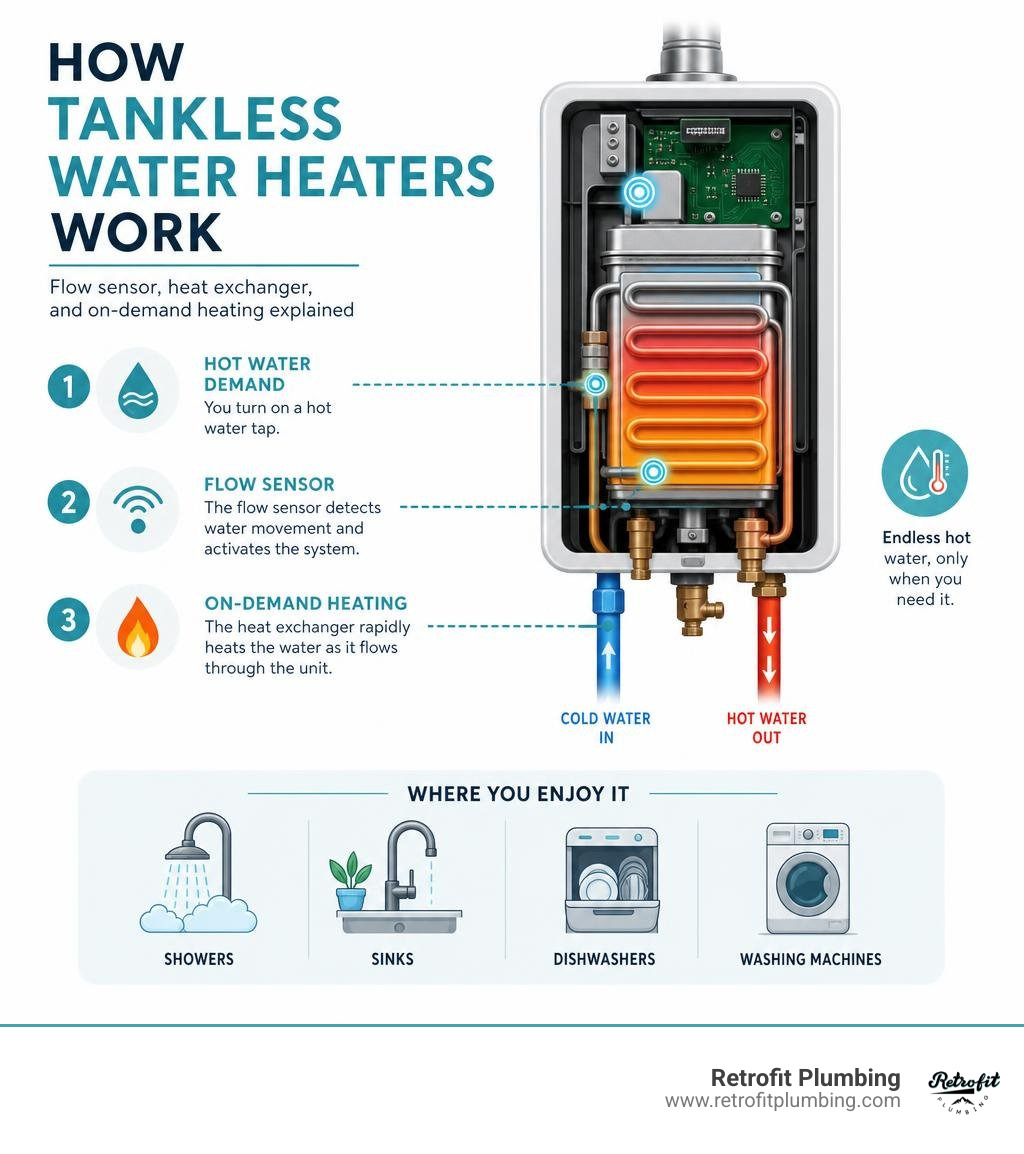
Unlike a traditional storage tank that continuously heats 40 to 80 gallons of water all day and night, demand-type systems remain completely idle until you turn on a hot water tap.
When you open a faucet in your kitchen or turn on the shower, cold water flows into the unit. A highly sensitive flow sensor detects this movement and immediately signals the burner (gas) or the heating elements (electric) to activate. The cold water is then routed through a powerful heat exchanger, which transfers thermal energy directly to the water in seconds. By the time the water exits the unit, it has reached your target temperature.
At the heart of every tankless unit is the heat exchanger. The materials used here matter immensely:
- Copper Heat Exchangers: Copper is a phenomenal thermal conductor, transferring heat up to 25 times faster than stainless steel. This allows for rapid heating and highly efficient operation. It is commonly used in primary heat exchangers.
- Stainless Steel Heat Exchangers: Stainless steel excels at resisting corrosion and scale buildup, particularly in acidic environments or when dealing with hard municipal water. Many high-efficiency units use stainless steel for secondary heat exchangers to maximize longevity.
Point-of-Use vs. Whole-Home Systems
When planning your setup, you must choose between a centralized whole-home system or localized point-of-use (POU) units:
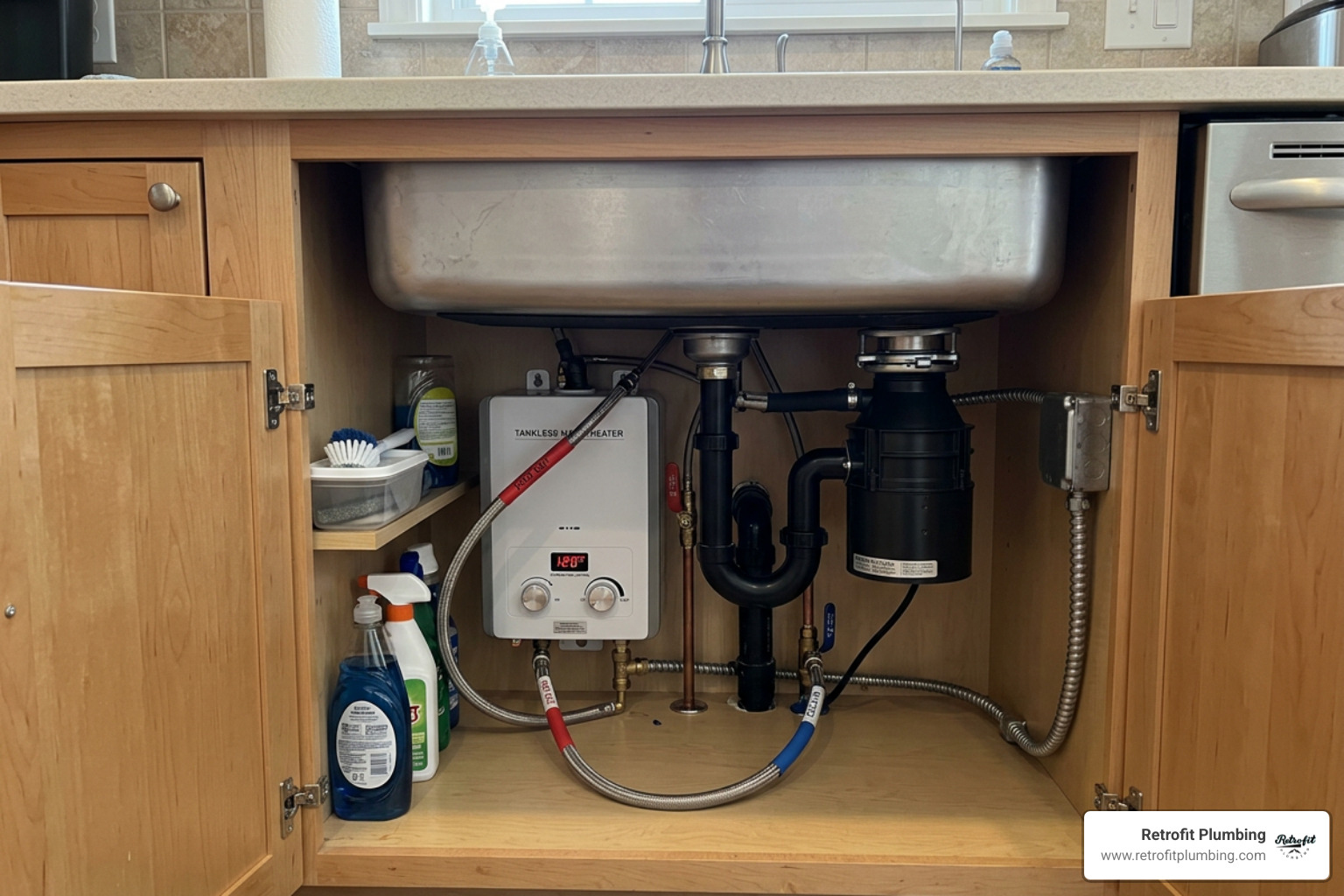
- Whole-Home Systems: These are larger, centralized units designed to supply hot water to every fixture in your house. They are perfect for replacing a central storage tank and are mounted on a wall in your garage, basement, or utility room.
- Point-of-Use (POU) Systems: These compact units are installed right next to a specific fixture, such as under a kitchen sink or in an outdoor workshop. They eliminate the "lag time" it takes for hot water to travel through long pipe runs. They are also popular as boosters for appliances like dishwashers or washing machines, and even for outdoor recreational vehicles—which you can read more about in our Propane Tankless Water Heater RV Guide.
Smart Features and Home Integration
Modern tankless water heaters are no longer simple mechanical boxes; they are fully integrated smart appliances. High-end electric models, like the Plus 208/220/240-Volt 27 Kw 4.5 GPM Wi-Fi Enabled Smart Electric Tankless Water Heater, feature built-in Wi-Fi connectivity.
These smart features allow you to:
- Control Temperature Remotely: Adjust your water temperature via a smartphone app or voice commands through Google Assistant or Amazon Alexa.
- Track Energy and Water Usage: Monitor exactly how much energy and water your household consumes.
- Receive Diagnostic Alerts: If a sensor detects scale buildup or a system error, the unit sends a push notification directly to your phone, allowing you to schedule proactive maintenance before a breakdown occurs.
Types of Tankless Water Heaters
Selecting the right fuel source and technology is the most critical step in your tankless journey. The options fall into distinct categories:
Electric Tankless Water Heaters
Electric units are highly efficient, compact, and relatively simple to install because they do not require venting. However, they demand a massive amount of electrical power. A whole-home electric unit can require up to three or four 40-amp double-pole breakers, meaning you will likely need to upgrade your home’s main electrical panel to 200 or 300 amps. If you are currently Replacing an Electric Water Heater of the traditional tank variety, we must carefully evaluate your home's electrical capacity before making the switch.
Gas Tankless Water Heaters
Gas-fired units are the heavy-hitters of the tankless world, delivering significantly higher flow rates than electric models. They are ideal for larger households in cold climates like ours. If you are planning a conversion, you can read our comprehensive Propane Tankless Hot Water Heater Guide to understand how gas systems operate. Within gas technology, you must choose between condensing and non-condensing models:
- Non-Condensing Units: These units heat water through a single heat exchanger and vent extremely hot exhaust gases (up to 400°F) directly outside. Because the exhaust is so hot, they require specialized, expensive Category III stainless steel venting. They typically have a Uniform Energy Factor (UEF) of around 0.80 to 0.82. A premier example is the Ultra-Low NOx Indoor 140,000 BTU Non-Condensing Natural Gas/Liquid Propane Tankless Water Heater | Model LTI-110U | Lochinvar, which is incredibly reliable and ideal for smaller homes or apartments.
- Condensing Units: These high-efficiency systems use a secondary heat exchanger to capture heat from the exhaust gases before they leave the unit. This cools the exhaust significantly (down to around 130°F), allowing us to vent the system using inexpensive PVC or ABS pipes. Condensing units achieve a stellar UEF of 0.95 to 0.96. The ProLine® XE Indoor 180,000 BTU Condensing Natural Gas Tankless Water Heater GTS-340-NIH 100 | State Water Heaters is an excellent commercial-grade residential option that utilizes this technology to maximize energy savings. Another exceptional condensing option is the Ultra-Low NOx Indoor 180,000 BTU Condensing Natural Gas Tankless Water Heater | Model LTI-340H-N | Lochinvar, which delivers continuous, high-volume performance for larger families. For homes without natural gas access, the Ultra-Low NOx Indoor 180,000 BTU Condensing Propane Tankless Water Heater | Model LTI-340H-P | Lochinvar provides the exact same high-efficiency condensing performance using liquid propane.
Hybrid Water Heaters
Hybrid systems combine the continuous flow of a tankless unit with a small, built-in insulated storage reservoir (usually 2 to 20 gallons). This design completely eliminates the brief delay in hot water delivery (known as the "cold water sandwich") and ensures a steady flow even during extremely low-demand situations where a standard tankless unit's flow sensor might not trigger.
Pros and Cons of Tankless Water Heaters
To help you weigh your options, let’s look at how tankless water heaters stack up against traditional storage tanks:
| Feature | Tankless Water Heaters | Traditional Tank Water Heaters |
|---|---|---|
| Lifespan | 20+ years | 10–15 years |
| Energy Efficiency | High (Up to 34% more efficient) | Low to Moderate (Suffers from standby loss) |
| Hot Water Supply | Endless (Subject to flow limits) | Limited to tank capacity |
| Physical Space | Extremely compact (Wall-mounted) | Large footprint (Takes up closet/floor space) |
| Upfront Cost | Higher ($2,500 – $6,000+ installed) | Lower ($1,200 – $2,500+ installed) |
| Maintenance | Annual descaling required | Minimal (Occasional flushing recommended) |
| Emissions | Low NOx models available | Higher overall emissions |
The Advantages Explained
- No Standby Energy Loss: Traditional tanks constantly cycle on and off to keep 50 gallons of water hot, even when you are asleep or away at work. Tankless systems only consume energy when you turn on a tap, eliminating this waste entirely.
- Unmatched Space Savings: A tankless unit is about the size of a carry-on suitcase and mounts directly to the wall. This can free up an entire utility closet in a Bellevue townhome or Covington rambler, allowing you to install a water softener or add extra storage.
- Longevity: Because tankless systems do not store water, they are far less prone to the rust and corrosion that eventually claim every traditional tank. A properly maintained tankless unit will easily last over two decades.
- Reduced Water Damage Risk: When a traditional tank fails, it often dumps dozens of gallons of rusty water onto your floor, leading to costly insurance claims. If a tankless unit experiences an issue, it simply stops heating, keeping your home safe from catastrophic flooding. If you ever experience issues with your existing tank, you can read our guide on Water Heater Leaks to mitigate damage.
The Drawbacks to Consider
- Higher Initial Investment: The purchase price and installation costs for a tankless system are higher, particularly if your home requires gas line upgrades or new venting paths.
- The "Cold Water Sandwich" Effect: If you turn the hot water faucet on, off, and immediately back on again, a small pocket of cold water that was sitting in the pipes can travel to your faucet between the two hot streams.
- Minimum Flow Activation: Tankless units require a minimum flow rate (usually around 0.5 GPM) to trigger the burners. If you only crack a faucet to a tiny trickle, the heater may not turn on.
Environmental and Financial Benefits
From an environmental standpoint, switching to a tankless unit is one of the most impactful upgrades you can make to your home. Traditional gas water heaters are major contributors to residential greenhouse gas emissions. Modern, high-efficiency tankless models are engineered to meet strict Ultra-Low NOx emission standards (reducing nitrogen oxide emissions to under 14 ng/J), significantly shrinking your household's carbon footprint.
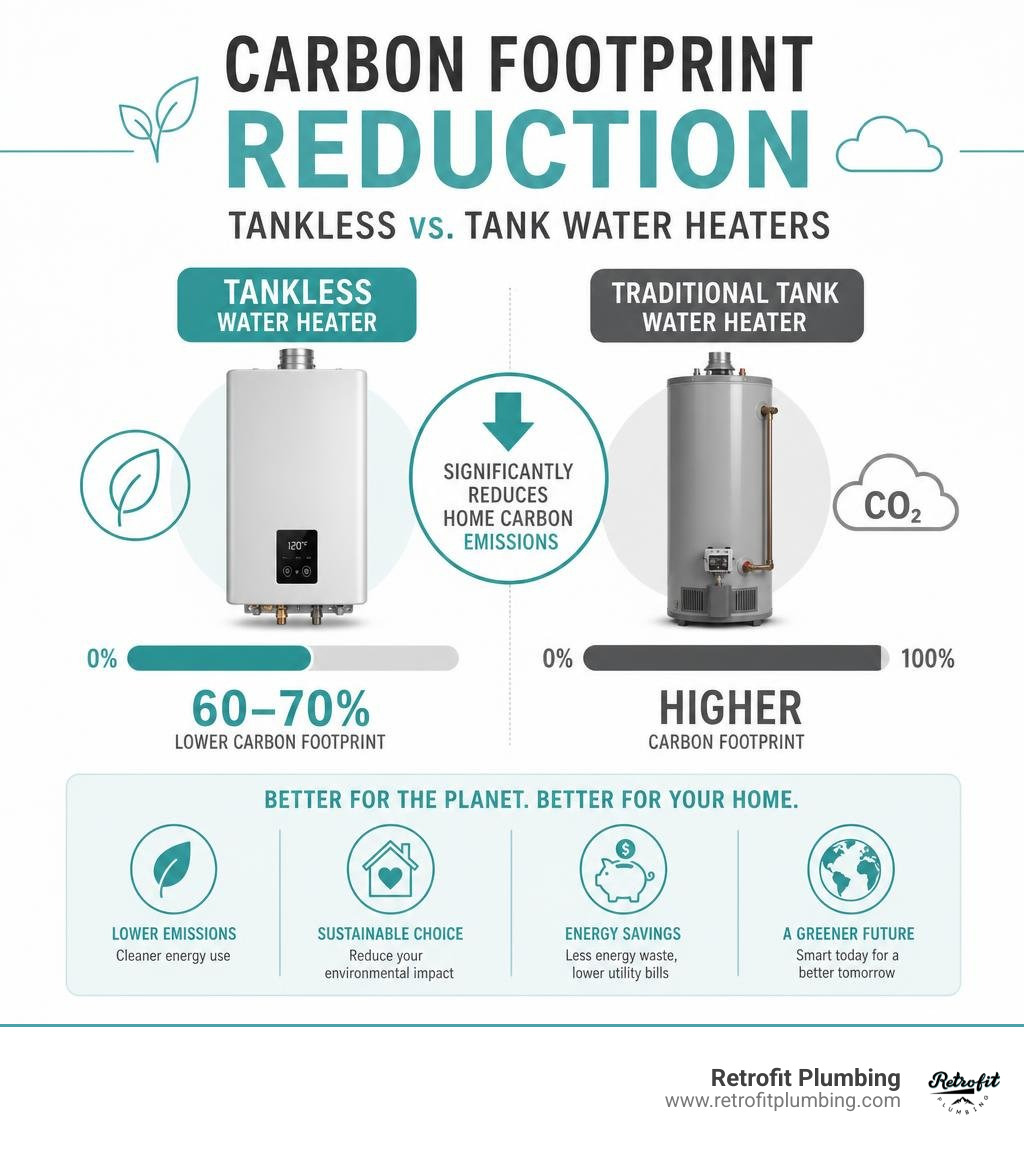
These environmental benefits translate directly into financial savings. According to data from the U.S. Department of Energy:
- For homes using 41 gallons or less of hot water daily, tankless water heaters can be 24% to 34% more energy efficient than conventional storage tanks.
- For busier homes using around 86 gallons of hot water per day, they still offer a 8% to 14% efficiency advantage.
Over the 20-year lifespan of a tankless system, these monthly utility bill savings, combined with the fact that you won't have to replace the unit nearly as quickly as a tank, easily offset the higher initial installation cost. You can dive deeper into these calculations in our Residential Tankless Water Heater Guide 2026.
Sizing and Installing Your System
Sizing a tankless water heater is completely different from sizing a tank. With a tank, you simply calculate how many gallons of hot water you need on standby. With a tankless system, you must calculate flow rate and temperature rise.
Sizing Your Tankless Water Heaters
To choose the perfect unit, we must perform a two-step calculation:
- Determine Peak Flow Rate (GPM):
Add up the flow rates of all the hot water fixtures you expect to run at the exact same time. For example:
- Low-flow showerhead: 1.5 to 2.0 GPM
- Kitchen faucet: 1.5 GPM
- Washing machine: 2.0 GPM
- If you want to run a shower and the washing machine simultaneously, your system must deliver at least 4.0 GPM.
- Calculate Required Temperature Rise:
This is the difference between your incoming groundwater temperature and your desired output temperature (typically 120°F).
- Crucial PNW Note: In western Washington, our groundwater is cold! In winter, municipal water entering your home from the Cedar River watershed or local aquifers can drop to a chilly 40°F to 45°F.
- To heat 40°F water up to a comfortable 120°F, your heater must achieve an 80°F temperature rise.
Because cold groundwater drastically reduces a heater's effective output, a unit rated for 8.0 GPM in sunny Florida might only deliver 4.5 to 5.0 GPM during a cold Covington December. This is why we recommend robust, high-BTU gas units like the Ultra-Low NOx Indoor 190,000 BTU Non-Condensing Natural Gas/Liquid Propane Tankless Water Heater | Model LTI-310U | Lochinvar for local homes with high hot water demands.
Installation Requirements and Maintenance
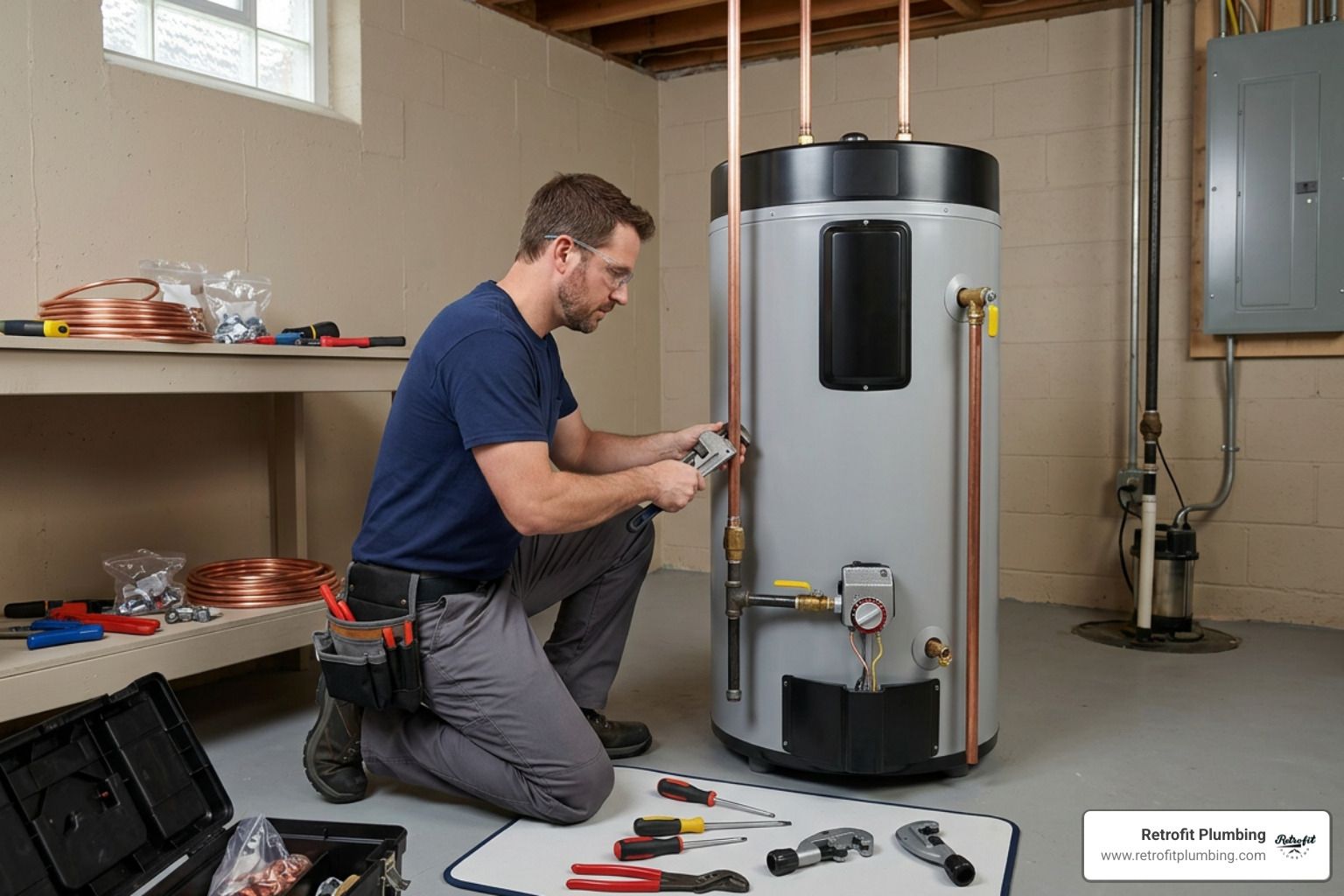
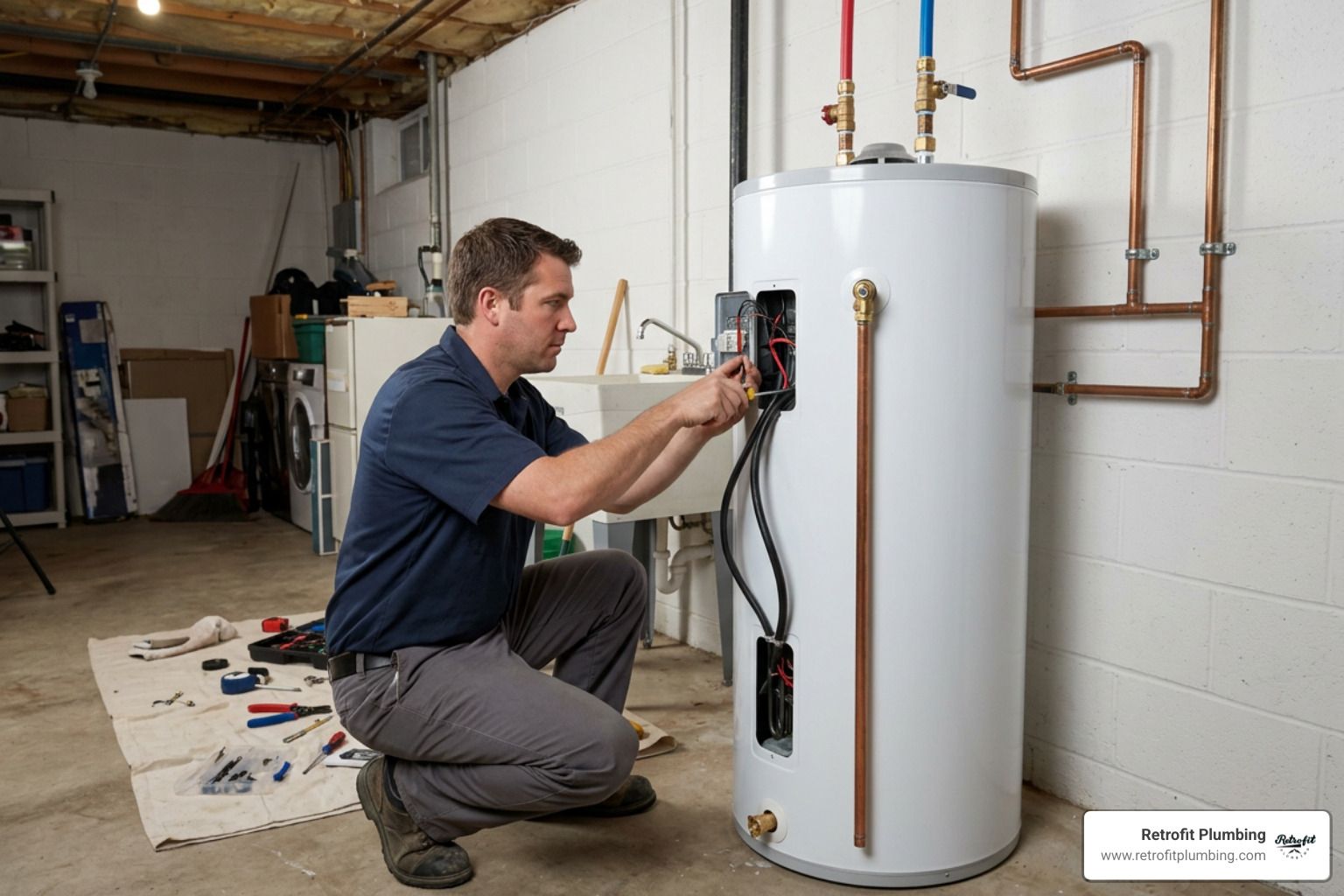
Installing a tankless water heater is a complex job that requires professional plumbing, electrical, and gas-fitting expertise. Key installation variables include:
- Venting Paths: Non-condensing units must be vented using specialized stainless steel pipe, while condensing units can use PVC. Venting can run horizontally through an exterior wall or vertically through the roof.
- Gas Line Upgrades: Standard tank heaters typically use a 1/2-inch gas line and burn around 40,000 BTUs. A whole-home tankless unit can demand up to 190,000 BTUs, which often requires upgrading the gas line to a 3/4-inch pipe to prevent pressure drops.
- Condensate Drains: High-efficiency condensing units produce acidic condensation during operation. We must route this condensation through a neutralizing cartridge and into a nearby floor drain or sump pump.
The Pacific Northwest Maintenance Reality
While tankless units are incredibly durable, they are not maintenance-free. Here in Western Washington, our water carries mild mineral content that can slowly bake onto the copper coils of your heat exchanger over time, creating an insulating barrier of scale. This forces the unit to run hotter and work harder, reducing efficiency and eventually causing system failure.
We recommend annual professional descaling. This process involves flushing a food-grade citric acid solution through the heater’s service valves for about an hour to dissolve mineral scale.
Additionally, our local environment poses unique physical challenges. If your unit vents to the outdoors, falling Douglas fir needles, bigleaf maple leaves, and nesting local spiders can easily clog the intake or exhaust vents. During our seasonal maintenance visits, we always clear these vents to prevent safety sensors from shutting down your system. If your system ever stops heating or displays an error code, do not hesitate to contact our team for immediate Water Heater Repair.
Frequently Asked Questions
How long do tankless systems last?
With basic annual maintenance, a high-quality tankless water heater will easily last 20 to 25 years. This is nearly double the lifespan of a traditional tank, which typically fails within 10 to 15 years due to tank corrosion. You can learn more about local lifespans and common repairs in our Covington Water Heater Repair Guide.
Do these units provide instant hot water?
No. "Tankless" is not the same as "instant." The unit still takes a few seconds to detect flow and ignite the burners, and the hot water must still travel through your home’s plumbing pipes to reach your faucet. If your bathroom is far from the heater, you will still experience a delay. To solve this, we can install a dedicated recirculation pump that keeps hot water constantly moving through your main plumbing loop.
What safety features should I look for?
When shopping for a unit, ensure it carries recognized safety certifications (such as ETL or CSA) and look for these built-in safety mechanisms:
- Freeze Protection: Activates a small internal ceramic heater to prevent the heat exchanger from cracking during freezing winter nights.
- Overheat Cutoff Fuse: Instantly shuts down the system if internal temperatures exceed safe limits.
- Flame Sensors: Automatically cuts off the gas supply if the burner flame goes out unexpectedly.
Conclusion
Making the switch to a tankless water heater is an excellent way to modernize your home, slash your energy bills, and ensure your family never has to endure a cold shower again. However, because our Pacific Northwest groundwater is so cold and our local homes have unique layouts, a proper installation requires a tailored, professional approach.
At Retrofit Plumbing, we are proud to serve our neighbors throughout Covington, Bellevue, Renton, Kent, and the surrounding South Sound communities. We love living in this beautiful corner of the world—whether we're taking in stunning views of Mount Rainier on a clear day or enjoying local events like the Covington Days Festival.
As your local plumbing experts, we are committed to providing honest pricing, fully stocked trucks, same-day service, and a 100% satisfaction guarantee. Whether you need a quick repair on an existing system or a complete whole-home tankless conversion, we are here to help.
Ready to explore your options? Contact us today to schedule a consultation or learn more about our professional Tankless Water Heaters installation services!
Local Permitting and Code Resources
If you are researching local installation requirements, plumbing codes, and permitting processes across King County and the Puget Sound, you can consult these official municipal resources:
- Covington: Check out the City of Covington Permit Services for local residential plumbing guidelines.
- Bellevue: Review the City of Bellevue Development Services for water heater installation permits.
- Renton: Visit the City of Renton Permit Center to understand local utility connection codes.
- Kent: Access the City of Kent Permit Department for plumbing and mechanical permit applications.